
By Howard Nguyen, PhD, Founder & CEO, Vital CKM, Inc. — Published 9/5/2026
For decades, medicine has treated heart disease, kidney disease, diabetes, and obesity as separate diagnoses, each with its own specialist, its own lab panel, and its own treatment guideline. But a growing body of clinical evidence — beginning with a 2023 presidential advisory from the American Heart Association and formalized in June 2026 into the first joint clinical practice guideline issued together by the American Heart Association, American College of Cardiology, American Diabetes Association, and American Society of Nephrology — has made the case that these conditions aren’t really separate at all. They’re different faces of a single, interconnected disease process now formally named Cardiovascular-Kidney-Metabolic (CKM) syndrome. [1, 2]
Understanding CKM syndrome starts with a simple but consequential shift in perspective: instead of asking “what’s wrong with this organ,” ask “what’s wrong with this system.” Here’s what that system looks like, how its parts depend on each other, and why a failure in one organ so often drags the others down with it.
Vital CKM, Inc. is an independent company and is not affiliated with, sponsored by, or endorsed by the American Heart Association, American College of Cardiology, American Diabetes Association, or American Society of Nephrology. The clinical framework and staging described below originate from their published guideline [1] and are summarized here for educational purposes, in our own words, with citations to the original sources.
Three systems, one shared circulation
At the center of CKM syndrome are three organ systems that seem, on the surface, to do very different jobs.
The metabolic system — primarily fat tissue, the liver, and the pancreas — stores and releases energy and manages blood sugar through insulin. The kidneys filter roughly 50 gallons of blood a day, clear metabolic waste, and regulate fluid, electrolytes, and blood pressure. The heart and vessels pump oxygenated blood to every tissue in the body and clear deoxygenated blood back out, through a vascular network that is highly sensitive to what’s circulating in it.
The reason these three systems can’t be treated independently is that they share the same bloodstream. Every hormone the pancreas releases, every waste product the kidneys are supposed to clear, and every lipid particle drifting through the arteries touches all three systems at once. That shared circulation is what turns a problem in one organ into a problem for all of them. [3]
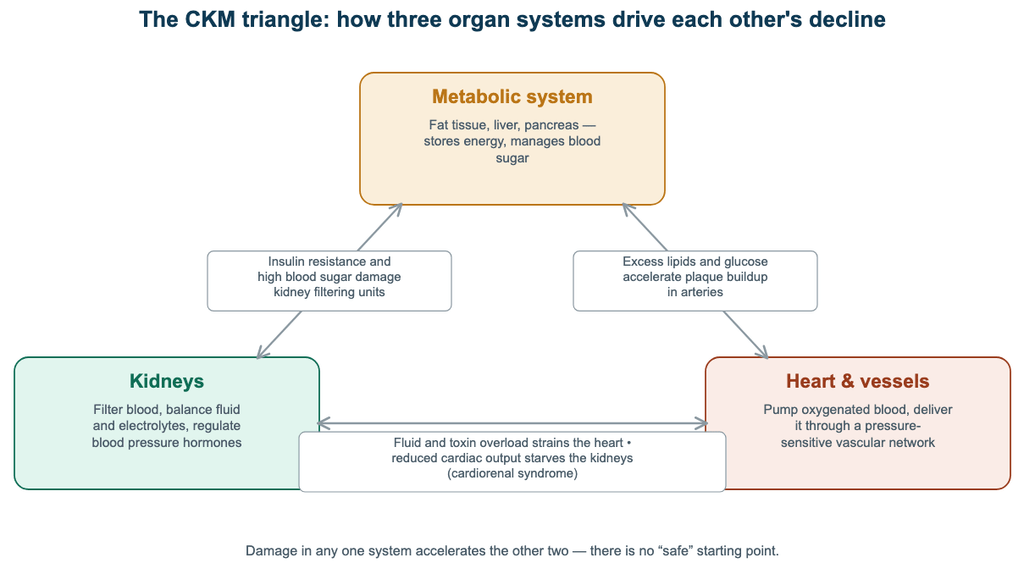
How damage moves around the triangle
The relationships between these three systems aren’t one-directional — they form a closed loop, which is exactly why CKM syndrome is so difficult to reverse once it takes hold.
Metabolic dysfunction damages the kidneys. When fat tissue becomes overloaded, it stops responding normally to insulin. The resulting insulin resistance and chronically elevated blood sugar directly injure the glomeruli — the kidney’s microscopic filtering units — causing protein to leak into the urine and filtration capacity to decline, often silently, years before a patient feels anything. [3]
Metabolic dysfunction damages the heart and vessels. The same dysfunctional fat tissue drives high triglycerides, low HDL cholesterol, and elevated blood pressure. That combination accelerates atherosclerosis — plaque building up inside artery walls — raising the risk of heart attack, stroke, and peripheral artery disease. [2, 3]
Failing kidneys strain the heart. When kidneys can’t clear sodium and fluid properly, blood volume and blood pressure rise, forcing the heart to work harder against greater resistance. Over time this contributes to heart failure. Kidneys also fail to clear certain metabolic toxins that directly injure heart muscle and blood vessels.
A failing heart strains the kidneys. A weakened heart can’t pump enough blood forward, which means the kidneys receive less blood flow and oxygen than they need. This bidirectional relationship between heart and kidney failure — where dysfunction in either organ triggers dysfunction in the other — is a well-established clinical entity known as cardiorenal syndrome. [4]
A failing heart worsens metabolism. Poor circulation and the chronic low-grade inflammation that accompanies cardiovascular disease feed back into insulin resistance, completing the loop. [3]
This is why CKM syndrome is best pictured as a triangle rather than a chain: there’s no organ where damage stays contained, and no “safe” place for the problem to start.
A framework for staging, not just diagnosing
Recognizing this interconnection led the American Heart Association to introduce a staging system for CKM syndrome in 2023 — a way of describing where a patient sits along the entire spectrum, rather than diagnosing each condition separately after damage has already occurred. That staging system is now the backbone of the first joint clinical practice guideline on CKM syndrome, issued in June 2026 by the American Heart Association, American College of Cardiology, American Diabetes Association, and American Society of Nephrology together. [1, 2]
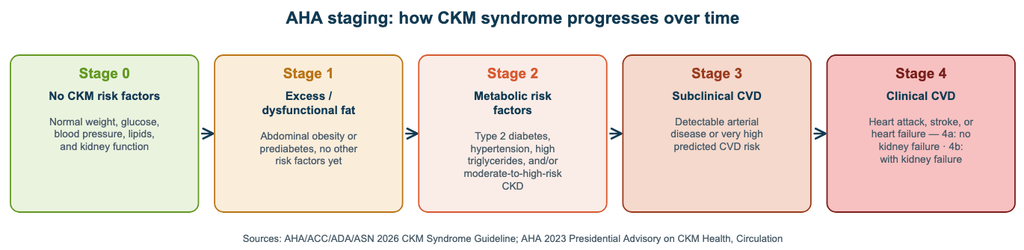
- Stage 0 describes a person with no CKM risk factors at all — normal weight, glucose, blood pressure, lipids, and kidney function. The clinical goal here is simply staying there.
- Stage 1 introduces excess or dysfunctional fat tissue — abdominal obesity or prediabetes — without yet triggering other metabolic problems.
- Stage 2 marks the arrival of established risk factors: type 2 diabetes, hypertension, high triglycerides, and/or moderate-to-high-risk chronic kidney disease.
- Stage 3 is defined by subclinical cardiovascular disease — measurable but not yet symptomatic, such as detectable arterial calcium — combined with ongoing metabolic or kidney risk.
- Stage 4 describes symptomatic cardiovascular disease: heart attack, stroke, or heart failure. This final stage splits further into 4a (no kidney failure) and 4b (with kidney failure), reflecting just how much worse outcomes become once the kidneys are involved. [1]
The value of this staging system is that it gives clinicians — and increasingly, AI-based risk models — a way to catch deterioration early, at Stage 1 or 2, long before it reaches the point of irreversible organ damage at Stage 3 or 4.
Why this matters for how we build risk models
Most cardiovascular risk calculators in wide use today were built decades ago, using cholesterol and blood pressure alone, from population data that no longer reflects how people actually get sick. They were never designed to account for the CKM triangle — the reality that a patient’s true cardiovascular risk depends as much on their kidney function and metabolic markers as it does on their lipid panel.
That gap is the reason a growing number of clinical data scientists are rebuilding cardiovascular risk models from the ground up around CKM syndrome — pulling cardiac, renal, and metabolic data together into a single view of a patient, rather than treating them as three separate charts reviewed by three separate specialists.
The organ systems have always worked as one triangle. It’s the tools we use to measure and predict their risk that are finally catching up.
References
- Ndumele CE, Rodriguez F, Dixon DL, Khan SS, Mukherjee D, Bajaj M, et al. 2026 AHA/ACC/ADA/ASN Guideline for the Prevention, Detection, Evaluation, and Management of Cardiovascular-Kidney-Metabolic Syndrome: A Report of the American College of Cardiology/American Heart Association Joint Committee on Clinical Practice Guidelines. Journal of the American College of Cardiology. 2026;87(22 Suppl):e1889–e2007. doi:10.1016/j.jacc.2026.03.056
- Ndumele CE, Rangaswami J, Chow SL, et al. Cardiovascular-Kidney-Metabolic Health: A Presidential Advisory From the American Heart Association. Circulation. 2023;148(20):1606–1635. doi:10.1161/CIR.0000000000001184
- Ndumele CE, Neeland IJ, Tuttle KR, et al. A Synopsis of the Evidence for the Science and Clinical Management of Cardiovascular-Kidney-Metabolic (CKM) Syndrome: A Scientific Statement From the American Heart Association. Circulation. 2023;148(20):1636–1664.
- Ronco C, Haapio M, House AA, Anavekar N, Bellomo R. Cardiorenal Syndrome. Journal of the American College of Cardiology. 2008;52(19):1527–1539. doi:10.1016/j.jacc.2008.07.051